Free Standard Shipping on orders $150+ • $6 Priority Upgrade Available

Batch ID
10MS626
Assay Purity (HPLC)
99.81%
QC Status
Pass
Analysis Date
07-25-2026
Product Overview
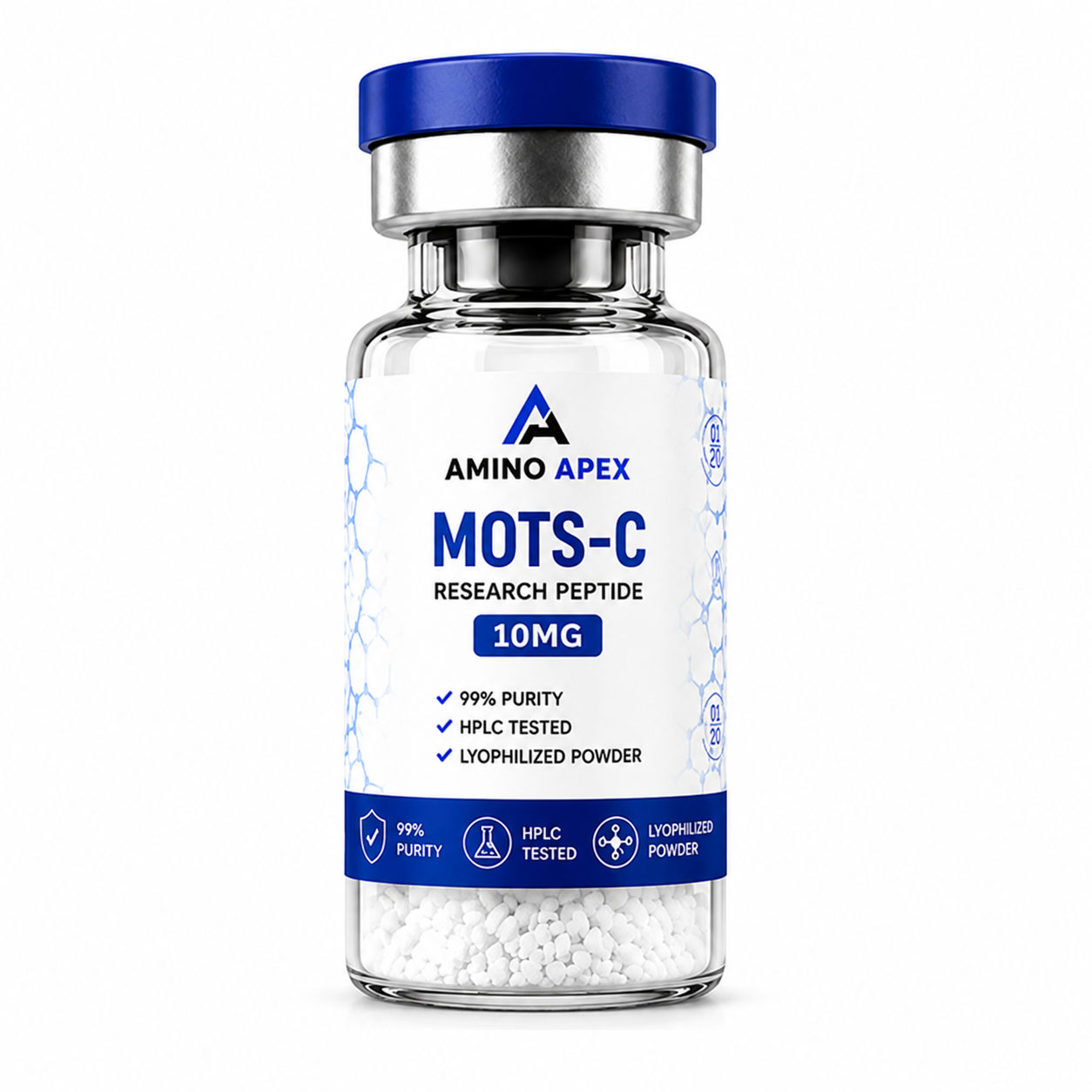
MOTS-C 10mg
Compound Overview
MOTS-C 10mg is a lyophilized mitochondrial-derived peptide preparation supplied by Amino Apex for qualified laboratory research. MOTS-c is a 16-amino-acid peptide encoded by a short open reading frame within the mitochondrial 12S ribosomal RNA region (MT-RNR1). It has been investigated in experimental studies involving cellular energy metabolism, metabolic stress responses, AMP-activated protein kinase (AMPK) signaling, and mitochondrial–nuclear communication. Preclinical research has examined MOTS-c in relation to metabolic homeostasis, glucose utilization, one-carbon metabolism, and adaptive cellular stress responses. Experimental findings suggest that MOTS-c participates in signaling pathways associated with cellular energy regulation. Under certain metabolic stress conditions, MOTS-c has also been observed to translocate into the nucleus, where it may interact with chromatin and stress-responsive transcriptional regulators. A 2015 peer-reviewed study published in Cell Metabolism investigated MOTS-c activity in experimental cellular and mouse models. Researchers examined its relationship with metabolic homeostasis, AMPK signaling, and cellular responses associated with energy metabolism. Additional research has investigated MOTS-c as a potential signaling mediator between mitochondria and the nucleus. A 2018 peer-reviewed study published in Cell Metabolism examined stress-associated nuclear translocation of MOTS-c and its relationship with adaptive gene-expression responses. These publications provide scientific background and do not establish therapeutic effectiveness or safety for the Amino Apex research material.Molecular & Structural Research
MOTS-c consists of 16 amino-acid residues with the sequence:
MRWQEMGYIFYPRKLR
Three-letter representation:
Met-Arg-Trp-Gln-Glu-Met-Gly-Tyr-Ile-Phe-Tyr-Pro-Arg-Lys-Leu-Arg
Structural notation:
H-Met-Arg-Trp-Gln-Glu-Met-Gly-Tyr-Ile-Phe-Tyr-Pro-Arg-Lys-Leu-Arg-OH
Its molecular formula is:
C₁₀₁H₁₅₂N₂₈O₂₂S₂
with an approximate molecular mass of:
2,174.6 g/mol
MOTS-c is associated with CAS Number 1627580-64-6.
Research has examined MOTS-c as a molecular signal connecting mitochondrial metabolic status with cytoplasmic and nuclear regulatory pathways, including AMPK activation and stress-responsive gene regulation.
Research Applications
MOTS-c may be studied in appropriately designed laboratory research involving:
- Mitochondrial-derived peptide biology
- AMPK-associated signaling
- Cellular energy metabolism
- Mitochondrial-to-nuclear communication
- Metabolic-stress responses
- Folate-methionine cycle research
- De novo purine biosynthesis
- AICAR-associated metabolic signaling
- Glucose-utilization pathways
- Fatty-acid metabolism
- Cellular redox regulation
- NRF2-associated signaling
- Adaptive gene-expression research
- Chromatin-associated peptide signaling
- Mitochondrial stress-response pathways
- Analytical peptide characterization
Experimental work indicates that MOTS-c can influence the folate-methionine cycle, leading to accumulation of AICAR and activation of AMPK-associated pathways.
These categories describe areas of scientific investigation and do not constitute therapeutic or clinical-use recommendations.
Preclinical Research Context
MOTS-c has been investigated primarily through biochemical studies, cultured-cell systems, animal models, and emerging human physiology research.
Experimental studies have examined its relationship with cellular glucose uptake, metabolic flexibility, mitochondrial signaling, fatty-acid utilization, redox regulation, and adaptive responses to energetic stress.
Research has also demonstrated that metabolic stress can promote AMPK-dependent nuclear translocation of MOTS-c. Within the nucleus, MOTS-c has been reported to associate with chromatin and interact with stress-responsive transcription factors including NRF2 and ATF1, linking mitochondrial signaling with nuclear gene-expression responses.
The molecular mechanisms of MOTS-c remain an active area of investigation, and results from experimental systems should not be assumed to establish clinical safety, efficacy, or therapeutic effects.
Analytical Documentation
Amino Apex provides batch-specific analytical documentation for tested lots. Individual lot documentation may include chromatographic purity analysis and other analytical information associated with the tested sample.
Because analytical characteristics may differ by production lot, the Certificate of Analysis for the applicable batch should be used as the source of measured purity and quality-control results.
Refer to the COA panel on this page or the Amino Apex COA Library for available batch documentation.
Storage & Laboratory Handling
This material should be handled only by qualified personnel using procedures appropriate for laboratory peptide materials.
Storage and handling should follow the conditions specified in the applicable product and batch documentation.
Experimental preparation, concentration, assay conditions, and analytical methodology should be established by qualified researchers according to the requirements of their specific laboratory system.
Research Use Only
For laboratory research use only.
This material is not intended for human or animal use. It is not intended for diagnostic, therapeutic, food, cosmetic, or household applications and is not intended to diagnose, treat, cure, prevent, or mitigate any disease or medical condition.
Lab Tested
Batch-specific testing
Verified COA
Lot documentation
Batch-Tested Purity
See current COA
Secure Packaging
Tamper-evident seal
Fast Shipping
Secure delivery
Research Use Only
Not for human use
Technical Specifications
Chemical Data & Compound Details
Product Name
MOTS-C 10mg
CAS Number
1627580-64-6
Molecular Formula
C101H152N28O22S2
Molar Mass
2174.6 g/mol
Appearance
Lyophilized Powder
Purity
99.81% — Current lot COA
Storage
Follow applicable product and batch documentation
Documentation
Batch-specific COA available
Intended Use
Laboratory research use only
Certificate Status
Pass

Questions About This Research Material?
Our support team can assist with questions regarding batch documentation, analytical specifications, COA availability, and laboratory storage information.
Qualified Support
Batch Documentation
COA Assistance
Core Standards
Why Choose Amino Apex?
Research Use Only
Supplied strictly for laboratory research and analytical applications.
Batch-Specific Testing
Analytical documentation is associated with individually identified product lots.
COA Documentation
Verified lot documentation is available through the Amino Apex COA Library.
Secure Fulfillment
Products are packaged securely and prepared according to our fulfillment procedures.
$65.00
$70.00
$45.00

$35.00
$35.00