Free Standard Shipping on orders $150+ • $6 Priority Upgrade Available
Batch ID
500ND826
Assay Purity (HPLC)
99.55%
QC Status
Pass
Analysis Date
07-24-2026
Product Overview
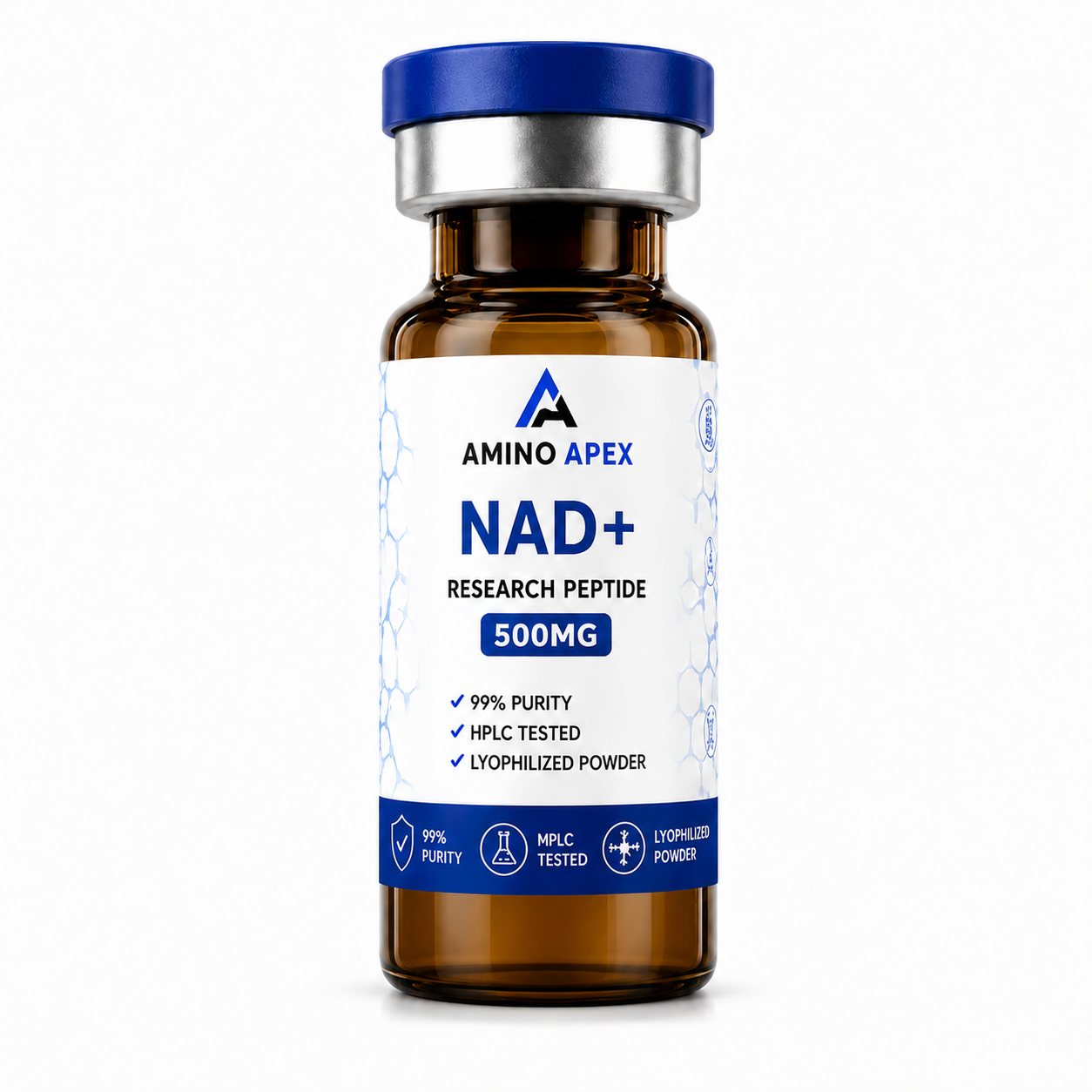
NAD+ 500mg
Compound Overview
NAD+ 500mg is a lyophilized nicotinamide adenine dinucleotide preparation supplied by Amino Apex for qualified laboratory research. NAD+ is a naturally occurring dinucleotide coenzyme present throughout cellular metabolism. It functions as a redox carrier and serves as a substrate for several classes of NAD-dependent enzymes, making it relevant to biochemical investigations involving cellular energy metabolism, mitochondrial function, and metabolic regulation.
The NAD+/NADH system plays a central role in oxidation-reduction reactions, allowing NAD+ to accept electrons during metabolic processes and become reduced to NADH. This reversible redox relationship is extensively studied in cellular energetics, mitochondrial function, metabolic regulation, and biochemical pathway analysis.
Beyond redox metabolism, NAD+ is also investigated as a substrate for sirtuins, poly(ADP-ribose) polymerases (PARPs), CD38-family enzymes, and other NAD-consuming systems involved in cellular signaling and metabolic regulation.
Published scientific literature has investigated NAD+ in relation to cellular energy metabolism, mitochondrial function, DNA repair, and NAD-dependent enzyme activity. A comprehensive overview of these biological processes is presented in the 2021 peer-reviewed NAD+ metabolism review published in Nature Reviews Molecular Cell Biology. The review discusses the roles of NAD+ in cellular signaling, sirtuin activity, PARP-associated pathways, and metabolic regulation. Additional research has examined the relationship between NAD+ availability, mitochondrial regulation, and cellular energy homeostasis. These mechanisms are discussed in the 2015 NAD+ metabolism and energy homeostasis review published in Cell Metabolism. These publications provide scientific background and do not establish therapeutic effectiveness or safety for the Amino Apex research material.Molecular & Structural Research
NAD+ consists of two nucleotide components connected through a pyrophosphate linkage: an adenine-containing nucleotide and a nicotinamide-containing nucleotide.
The nicotinamide portion of NAD+ serves as the principal redox-active site, accepting a hydride equivalent during reduction to form NADH.
For the commonly referenced oxidized free-acid form:
Chemical Name: Nicotinamide Adenine Dinucleotide
CAS Number: 53-84-9
Molecular Formula: C₂₁H₂₇N₇O₁₄P₂
Molecular Mass: approximately 663.43 g/mol
NAD+ is not a peptide and therefore does not possess an amino-acid sequence or peptide length.
Its molecular structure makes it particularly relevant to research involving electron transfer, enzyme-cofactor interactions, nucleotide chemistry, and metabolic pathway regulation.
Research Applications
NAD+ may be studied in appropriately designed laboratory research involving:
- Cellular redox metabolism
- NAD+/NADH ratio research
- Mitochondrial bioenergetics
- Oxidative metabolism
- Glycolytic and metabolic pathway research
- Electron-transfer reactions
- Sirtuin-associated signaling
- PARP-associated pathways
- CD38 and NAD-consuming enzyme research
- DNA-damage-response signaling
- Cellular stress-response pathways
- Metabolic enzyme activity
- Cellular senescence research
- Nucleotide-cofactor interactions
- Comparative metabolic research
- Analytical coenzyme characterization
These categories describe areas investigated in biochemical and cellular research and do not constitute therapeutic or clinical-use recommendations.
Preclinical Research Context
NAD+ biology has been studied extensively across biochemical systems, cultured cells, animal models, and human physiology research.
Experimental research has examined changes in NAD+ availability and NAD-dependent signaling in relation to cellular metabolism, mitochondrial function, oxidative stress, DNA-damage responses, sirtuin activity, and cellular aging processes.
Because NAD+ participates in many interconnected biochemical pathways, experimental findings can vary substantially depending on the cell type, metabolic state, model system, enzyme activity, and experimental conditions.
Results obtained from experimental systems should therefore be interpreted within the specific design and limitations of the study rather than assumed to establish therapeutic effects.
Analytical Documentation
Amino Apex provides batch-specific analytical documentation for tested lots. Individual lot documentation may include chromatographic purity analysis and other analytical information associated with the tested sample.
Because analytical characteristics may differ by production lot, the Certificate of Analysis for the applicable batch should be used as the source of measured purity and quality-control results.
Refer to the COA panel on this page or the Amino Apex COA Library for available batch documentation.
Storage & Laboratory Handling
This material should be handled only by qualified personnel using procedures appropriate for laboratory biochemical reagents.
Storage and handling should follow the conditions specified in the applicable product and batch documentation.
Experimental preparation, concentration, assay conditions, solution stability, and analytical methodology should be established by qualified researchers according to the requirements of their specific laboratory system.
Research Use Only
For laboratory research use only.
This material is not intended for human or animal use. It is not intended for diagnostic, therapeutic, food, cosmetic, or household applications and is not intended to diagnose, treat, cure, prevent, or mitigate any disease or medical condition.
Lab Tested
Batch-specific testing
Verified COA
Lot documentation
Batch-Tested Purity
See current COA
Secure Packaging
Tamper-evident seal
Fast Shipping
Secure delivery
Research Use Only
Not for human use
Technical Specifications
Chemical Data & Compound Details
Product Name
NAD+ 500mg
CAS Number
53-84-9
Molecular Formula
C21H27N7O14P2
Molar Mass
663.4 g/mol
Appearance
Lyophilized Powder
Purity
99.55% — Current lot COA
Storage
Follow applicable product and batch documentation
Documentation
Batch-specific COA available
Intended Use
Laboratory research use only
Certificate Status
Pass

Questions About This Research Material?
Our support team can assist with questions regarding batch documentation, analytical specifications, COA availability, and laboratory storage information.
Qualified Support
Batch Documentation
COA Assistance
Core Standards
Why Choose Amino Apex?
Research Use Only
Supplied strictly for laboratory research and analytical applications.
Batch-Specific Testing
Analytical documentation is associated with individually identified product lots.
COA Documentation
Verified lot documentation is available through the Amino Apex COA Library.
Secure Fulfillment
Products are packaged securely and prepared according to our fulfillment procedures.

$50.00
$55.00
$45.00
$40.00
$40.00