Free Standard Shipping on orders $150+ • $6 Priority Upgrade Available

Batch ID
5OT926
Assay Purity (HPLC)
99.54%
QC Status
Pass
Analysis Date
09-01-2026
Product Overview
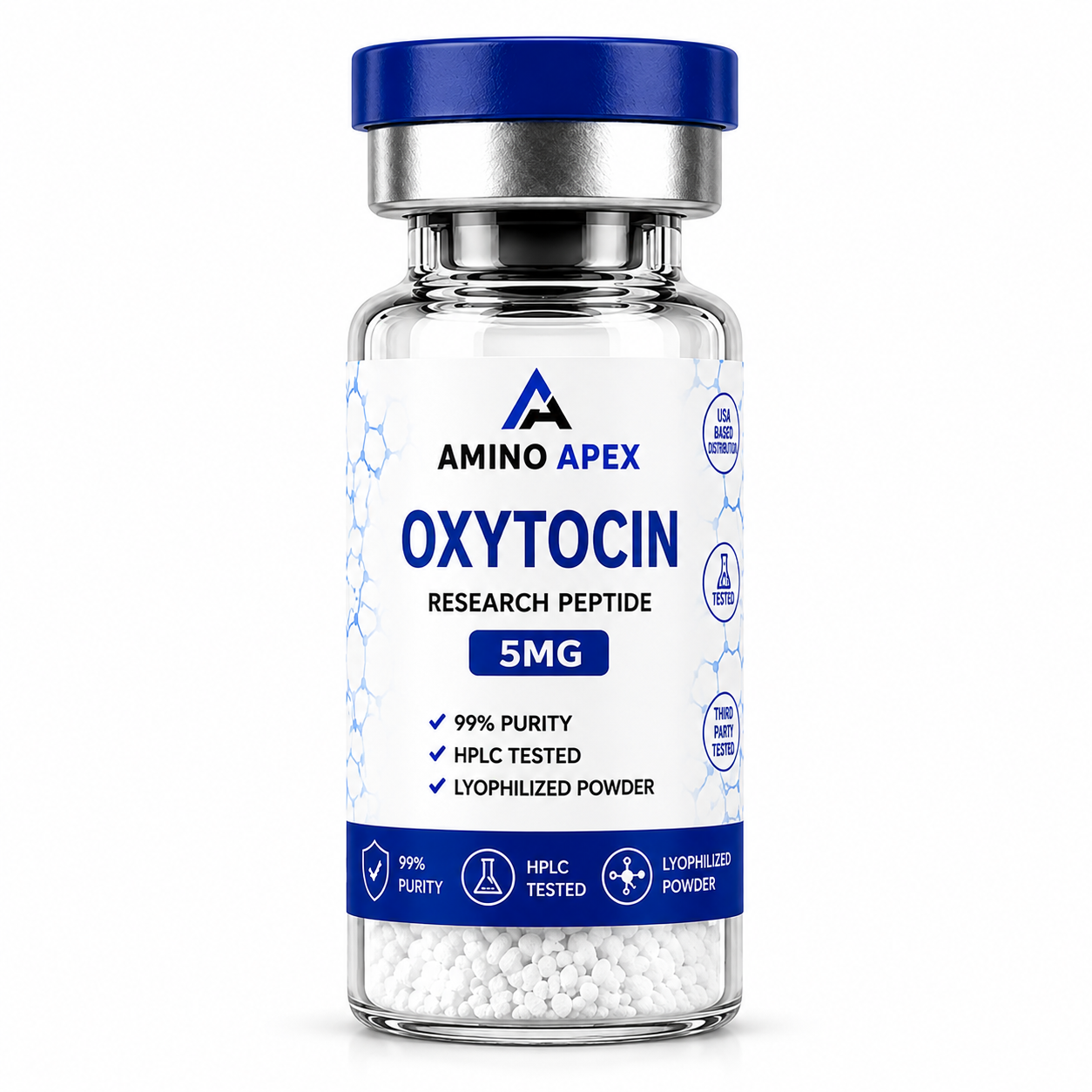
Oxytocin 5mg
Compound Overview
Oxytocin 5mg is a lyophilized synthetic nonapeptide preparation supplied by Amino Apex for qualified laboratory research. Oxytocin is a naturally occurring cyclic peptide hormone composed of nine amino-acid residues. It functions as both a neurohypophyseal hormone and a signaling neuropeptide, making it relevant to investigations involving neuroendocrine regulation, peptide-receptor interactions, and cellular signaling mechanisms. Experimental research has extensively characterized oxytocin's interactions with the oxytocin receptor (OXTR), a G protein-coupled receptor involved in multiple intracellular signaling pathways. Classical OXTR activation involves Gαq/11-mediated phospholipase C (PLC) signaling, generating inositol trisphosphate (IP3) and diacylglycerol (DAG). These pathways contribute to intracellular calcium mobilization, protein kinase C activation, and downstream cellular responses. A 2018 peer-reviewed review published in Physiological Reviews examined oxytocin receptor biology, intracellular signaling mechanisms, and receptor-associated responses in central and peripheral physiological systems. The publication discusses OXTR signaling through G proteins and downstream pathways involving PLC, PKC, MAPK, and other regulatory mechanisms. Additional structural research has investigated the molecular interactions between oxytocin and its receptor. A 2022 peer-reviewed study published in Nature Communications used cryo-electron microscopy to characterize the active human oxytocin receptor bound to oxytocin, providing structural insights into ligand recognition, receptor activation, and receptor selectivity. These publications provide scientific background and do not establish the safety, efficacy, or suitability of the Amino Apex research material for clinical use.Molecular & Structural Research
Oxytocin consists of 9 amino-acid residues with the sequence:
CYIQNCPLG-NH₂
Three-letter representation:
Cys-Tyr-Ile-Gln-Asn-Cys-Pro-Leu-Gly-NH₂
A disulfide bond between Cys1 and Cys6 forms a six-residue cyclic region, while the remaining residues form a short C-terminal tail. This cyclic architecture is a defining structural feature of oxytocin.
Its molecular formula is:
C₄₃H₆₆N₁₂O₁₂S₂
with an approximate molecular mass of:
1,007.2 g/mol
Oxytocin is associated with CAS Number 50-56-6.
Oxytocin shares structural characteristics with vasopressin, another cyclic neurohypophyseal nonapeptide, making the two peptide systems relevant to comparative studies of sequence variation, receptor selectivity, peptide conformation, and GPCR signaling.
Research Applications
Oxytocin 5mg may be studied in appropriately designed laboratory research involving the following molecular and cellular pathways:- Oxytocin receptor (OXTR) signaling
- G-protein-coupled receptor pharmacology
- Gαq/11-associated signaling
- Phospholipase C signaling
- IP₃ and DAG-associated pathways
- Intracellular calcium mobilization
- Protein kinase C signaling
- MAPK-associated pathways
- Neuroendocrine signaling
- Neuronal and synaptic signaling
- Smooth-muscle cellular signaling
- Receptor regulation and desensitization
- Peptide-receptor interaction studies
- Comparative oxytocin/vasopressin research
- Cyclic peptide structure-function studies
- Analytical peptide characterization
OXTR activation is particularly well characterized through the Gq/PLC/IP₃ pathway, which produces changes in intracellular calcium and downstream cellular signaling.
These categories describe areas of scientific investigation and do not constitute therapeutic or clinical-use recommendations.
Preclinical Research Context
Oxytocin biology has been investigated extensively across biochemical systems, receptor-expression models, cultured cells, animal studies, and human physiology research.
Research has examined OXTR signaling in reproductive, neuronal, cardiovascular, and other cellular systems, with receptor responses varying according to tissue type, receptor expression, intracellular signaling machinery, and experimental conditions.
At the molecular level, research has characterized Gq/11-mediated PLC activation, calcium mobilization, PKC signaling, receptor phosphorylation, β-arrestin recruitment, and receptor internalization/desensitization.
Although oxytocin itself has an established clinical pharmacology, findings from published studies should not be assumed to establish the characteristics, safety, efficacy, or intended use of an individual Amino Apex research-material lot.
Analytical Documentation
Amino Apex provides batch-specific analytical documentation for tested lots. Individual lot documentation may include chromatographic purity analysis and other analytical information associated with the tested sample.
Because analytical characteristics may differ by production lot, the Certificate of Analysis for the applicable batch should be used as the source of measured purity and quality-control results.
Refer to the COA panel on this page or the Amino Apex COA Library for available batch documentation.Storage & Laboratory Handling
This material should be handled only by qualified personnel using procedures appropriate for laboratory peptide materials.
Storage and handling should follow the conditions specified in the applicable product and batch documentation.
Experimental preparation, concentration, assay conditions, and analytical methodology should be established by qualified researchers according to the requirements of their specific laboratory system.
Research Use Only
For laboratory research use only.
This material is not intended for human or animal use. It is not intended for diagnostic, therapeutic, food, cosmetic, or household applications and is not intended to diagnose, treat, cure, prevent, or mitigate any disease or medical condition.
Lab Tested
Batch-specific testing
Verified COA
Lot documentation
Batch-Tested Purity
See current COA
Secure Packaging
Tamper-evident seal
Fast Shipping
Secure delivery
Research Use Only
Not for human use
Technical Specifications
Chemical Data & Compound Details
Product Name
Oxytocin 5mg
CAS Number
50-56-6
Molecular Formula
C₄₃H₆₆N₁₂O₁₂S₂
Molar Mass
1007.19 g/mol
Appearance
White to off-white lyophilized powder
Purity
99.54% — Current lot COA
Storage
Follow applicable product and batch documentation
Documentation
Batch-specific COA available
Intended Use
Laboratory research use only
Certificate Status
Pass

Questions About This Research Material?
Our support team can assist with questions regarding batch documentation, analytical specifications, COA availability, and laboratory storage information.
Qualified Support
Batch Documentation
COA Assistance
Core Standards
Why Choose Amino Apex?
Research Use Only
Supplied strictly for laboratory research and analytical applications.
Batch-Specific Testing
Analytical documentation is associated with individually identified product lots.
COA Documentation
Verified lot documentation is available through the Amino Apex COA Library.
Secure Fulfillment
Products are packaged securely and prepared according to our fulfillment procedures.
$85.00
$70.00
$45.00
$35.00
$35.00